
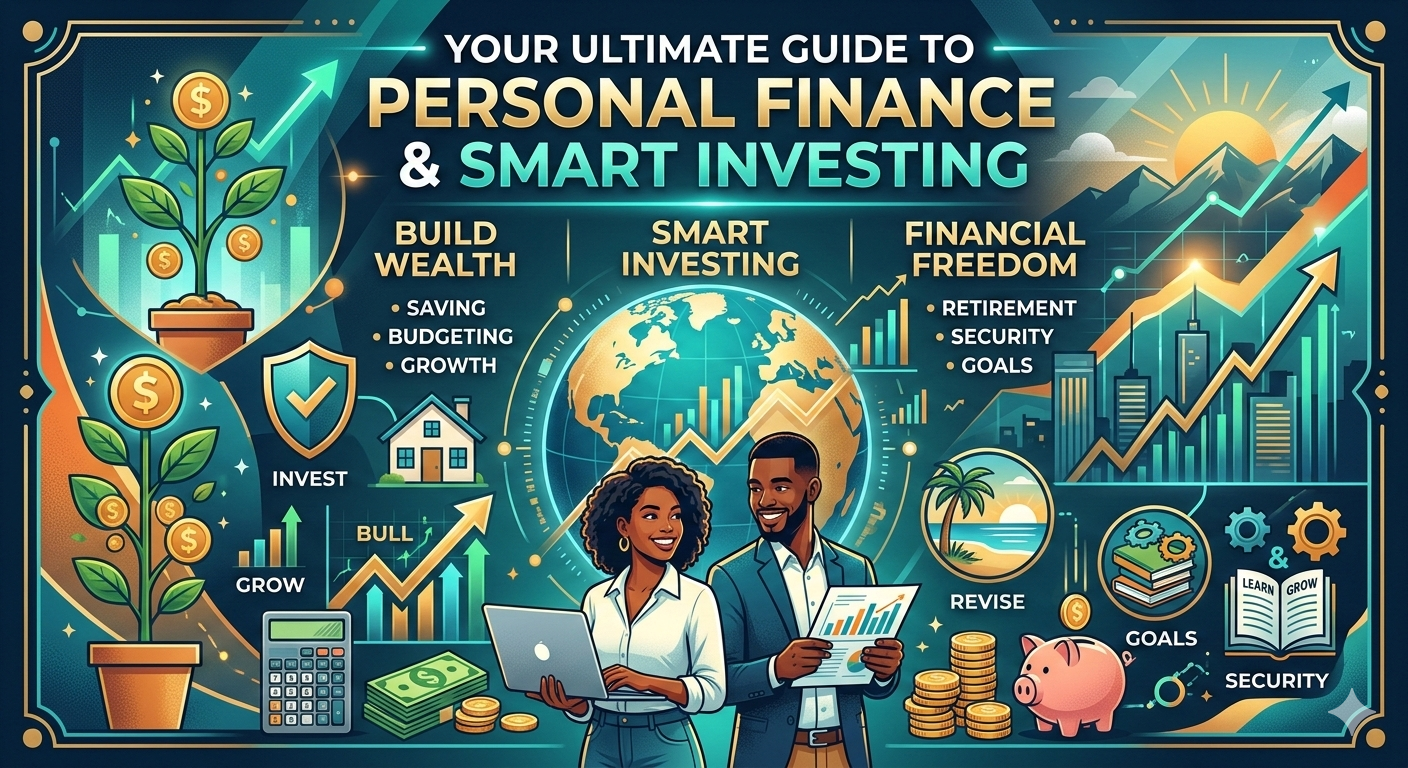
Mastering Your Wealth: The 2024 Ultimate Guide to Personal Finance and Smart Investing
In an era of fluctuating inflation rates, shifting job markets, and the rapid rise of digital assets, the quest for financial freedom has never been more relevant—or more complex. Have you ever wondered why some people seem to grow their wealth effortlessly while others struggle to make ends meet despite a high salary? The secret doesn’t lie in a “get rich quick” scheme; it lies in the mastery of personal finance and the disciplined application of smart investing strategies. This guide is designed to take you from financial uncertainty to a position of strength, providing a roadmap to build, protect, and grow your wealth in today’s economy.
1. The Foundation: Shifting from a Consumer to an Investor Mindset
Before looking at stock tickers or real estate listings, the most critical shift must happen internally. Personal finance is 20% head knowledge and 80% behavior. The goal is to move from a mindset of “how much can I spend?” to “how much can I deploy?”
The New 50/30/20 Rule
Traditional budgeting often feels like a restriction, but modern personal finance views it as an allocation of power. The 50/30/20 rule remains a gold standard, but with a twist for the modern age:
- 50% Needs: Housing, utilities, groceries, and insurance. In high-cost-of-living areas, this requires ruthless optimization.
- 30% Wants: Lifestyle choices. The key here is Value-Based Spending—cutting costs mercilessly on things that don’t bring joy to fund the things that do.
- 20% Financial Goals: This is your “Wealth Acceleration” fund. It covers debt repayment beyond minimums, emergency savings, and retirement contributions.
The Emergency Fund: Your Financial Shield
In a volatile economy, a liquid emergency fund is non-negotiable. Aim for 3-6 months of essential expenses (not income) stored in a High-Yield Savings Account (HYSA). With interest rates currently at decade-highs, your “stashed” cash can finally earn a respectable return while remaining accessible for life’s unexpected curveballs.
2. Debt Management: Identifying the “Wealth Killers”
Not all debt is created equal. To invest smartly, you must first clear the path. High-interest debt, specifically credit card debt ranging from 18% to 29%, is a financial emergency. No investment in the stock market will consistently beat a 25% guaranteed loss in interest payments.
The Avalanche vs. The Snowball
Two primary strategies dominate the debt-free journey:
- The Debt Avalanche: You pay the minimum on all debts and put every extra dollar toward the debt with the highest interest rate. This is mathematically the fastest way to become debt-free.
- The Debt Snowball: You pay the minimum on all debts and focus on the smallest balance first. This builds psychological momentum, which is often more effective for long-term behavioral change.
3. The Architecture of Smart Investing
Once your foundation is secure, it’s time to put your money to work. Investing is not gambling; it is the process of buying productive assets that generate value over time through compounding.
Understanding Asset Classes
Diversification is the only “free lunch” in investing. A robust portfolio typically spreads risk across several categories:
- Equities (Stocks): Buying shares of ownership in companies. While volatile in the short term, they have historically provided the highest long-term returns.
- Fixed Income (Bonds): Essentially lending money to governments or corporations in exchange for interest. These provide stability and income.
- Real Estate: Whether through physical property or REITs (Real Estate Investment Trusts), this offers a hedge against inflation and a source of passive income.
- Alternative Assets: This includes commodities (gold, silver), private equity, and digital assets like Bitcoin. These should generally comprise a small percentage (1-5%) of a diversified portfolio.
The Power of Index Funds and ETFs
For the vast majority of investors, trying to “beat the market” by picking individual stocks is a losing game. Data consistently shows that over a 15-year period, more than 90% of professional fund managers fail to outperform the S&P 500. Exchange-Traded Funds (ETFs) and Low-Cost Index Funds allow you to own a piece of the entire market for a fraction of a percent in fees. This “lazy” approach to investing is often the most profitable.
4. Strategic Tax Optimization: It’s Not What You Make, It’s What You Keep
High earners often lose a significant portion of their investment gains to taxes. Smart investing requires a “tax-aware” strategy. Utilizing the right “buckets” can save you hundreds of thousands of dollars over a lifetime.
Tax-Advantaged Accounts
- 401(k) / 403(b): If your employer offers a match, this is a 100% immediate return on your money. Never leave this on the table.
- Roth IRA: Contributions are made with after-tax dollars, but the money grows tax-free, and withdrawals in retirement are tax-free. This is a powerful tool for younger investors.
- Health Savings Account (HSA): Often called the “Triple Tax Advantage” account. Contributions are tax-deductible, growth is tax-free, and withdrawals for medical expenses are tax-free. If you don’t use it, it can function as a traditional IRA after age 65.
5. The Psychological Game: Avoiding Common Pitfalls
The greatest threat to your wealth isn’t a market crash—it’s your own reaction to it. Behavioral Finance teaches us that humans are hardwired to buy when things are expensive (fearing they’ll miss out) and sell when things are cheap (fearing further losses).
Dollar-Cost Averaging (DCA)
To remove emotion from investing, use Dollar-Cost Averaging. This involves investing a fixed amount of money at regular intervals, regardless of the price. When the market is down, your fixed dollar amount buys more shares. When the market is up, it buys fewer. Over time, this lowers your average cost per share and eliminates the stress of “timing the market.”
The Danger of “Lifestyle Creep”
As your career progresses and your income rises, there is a natural tendency to increase your standard of living. This “lifestyle creep” can anchor you to a desk for decades. To combat this, try to save 50% of every raise you receive. This allows you to enjoy your success today while dramatically accelerating your timeline to financial independence.
6. Investing in the Age of Artificial Intelligence
We are currently witnessing a technological shift comparable to the Industrial Revolution. AI is not just a buzzword; it is a fundamental shift in how value is created. Smart investors should look for companies that aren’t just “doing AI,” but are using it to fundamentally lower their costs or create new revenue streams. However, avoid the hype cycles. Stick to the “pick and shovel” providers—the infrastructure and semiconductor companies that make the technology possible—rather than speculative startups.
Conclusion: Your Action Plan for Wealth
Financial success is the result of small, consistent actions taken over a long period. You don’t need a six-figure salary to start; you just need a plan and the discipline to follow it.
Your immediate next steps:
- Calculate your current Net Worth (Assets minus Liabilities).
- Automate your savings so that your “Wealth Fund” is paid before you even see the money.
- Open a low-cost brokerage account and start a recurring investment into a total market index fund.
The best time to start was ten years ago; the second best time is today. By mastering the fundamentals of personal finance and committing to a long-term investment strategy, you aren’t just accumulating numbers in a bank account—you are buying your future freedom.
Ready to take control? Start by reviewing your last three months of bank statements and identifying three unnecessary expenses you can redirect toward your future self.