
Investing for Beginners: Start with Little Money, Best Index Funds, Roth vs Traditional IRAs, and Passive Income Ideas for Long-Term Wealth
Start Your Journey: Investing With Little Money
Many beginners mistakenly believe you need a fortune to start investing, but the reality is that starting small is the smartest strategy for long-term wealth. Thanks to modern financial platforms, you can now begin your investment journey with as little as $5 or $10, making it easier than ever to build a habit of consistent saving. Compound interest is your greatest ally here; by starting early, even tiny amounts can grow significantly over decades. Think of your early contributions as planting seeds that will eventually grow into a sturdy financial forest. Whether you are cutting back on daily lattes or finding small windfalls, every dollar counts toward your future freedom. It is not about the size of your initial deposit, but the consistency of your contributions that truly moves the needle. By automating your investments, you remove the emotional burden of timing the market. Remember, the goal is to build momentum, not to get rich overnight. Start today, and let the mathematics of wealth work in your favor while you focus on your personal financial goals.

The Power of Index Funds for Beginners
If you are looking for a simple, low-cost way to grow your money, index funds are undoubtedly your best friend. Instead of trying to pick individual winning stocks—which is notoriously difficult even for professionals—index funds allow you to own a tiny slice of hundreds or thousands of companies at once. This strategy provides instant diversification, significantly lowering your risk profile while tracking the overall performance of the market. Popular options like S&P 500 funds offer long-term historical returns that are difficult to beat with active trading. When you invest in an index fund, you are effectively betting on the growth of the global economy rather than a single firm’s success.
- Low Fees: Expenses are minimal compared to managed funds.
- Simplicity: You don’t need to monitor individual companies daily.
- Growth Potential: Historically tracks upward trends over long periods.
By keeping your investment expenses low, you keep more of your earnings compounding over time. It is the ultimate ‘set it and forget it’ tool for the long-term wealth builder. Focus on broad-market indices to ensure your portfolio stays balanced and resilient against market volatility.
Roth IRA vs. Traditional IRA: Tax Efficiency Explained
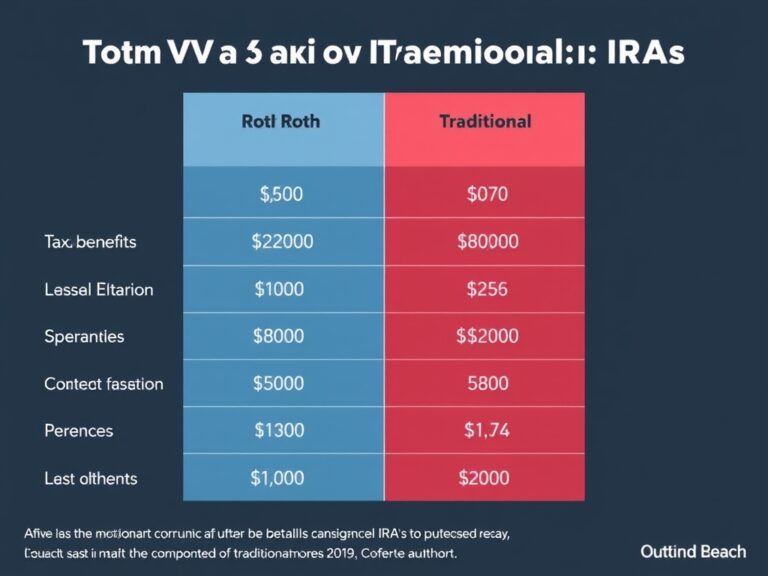
Understanding the difference between a Roth IRA and a Traditional IRA is vital for maximizing your net gains over your lifetime. With a Traditional IRA, you generally get a tax break today on the money you contribute, but you pay ordinary income taxes when you withdraw that money in retirement. In contrast, a Roth IRA asks you to pay taxes on your contributions upfront, but your investments grow completely tax-free, and qualified withdrawals during retirement are also tax-free. If you believe your tax bracket will be higher in the future, the Roth IRA is often the preferred path for long-term savers.
- Roth IRA: Pay taxes now, enjoy tax-free growth and tax-free retirement income.
- Traditional IRA: Get an immediate tax deduction, pay taxes later on distributions.
Choosing the right account depends on your current income level and your long-term outlook on tax rates. For younger investors early in their careers, the long-term benefit of tax-free growth in a Roth account is often impossible to beat. Speak with a financial professional if you are unsure, but do not let analysis paralysis stop you from opening an account. Getting started is always the most important step in financial planning.
Passive Income Ideas for Long-Term Wealth
Once you have established your core investment portfolio, you can start exploring passive income streams to accelerate your wealth-building journey. While index funds provide a form of passive capital appreciation, other assets can generate regular cash flow that you can reinvest to supercharge your compound growth. Consider dividend-paying stocks, which pay you a portion of company profits simply for holding the asset. Alternatively, real estate investment trusts (REITs) offer a way to gain exposure to the property market without the headache of being a landlord.
- Dividend Reinvestment: Use cash payouts to buy more shares automatically.
- REITs: Gain real estate exposure with the liquidity of a stock.
- High-Yield Savings: Keep your emergency fund in a high-yield account to earn interest.
Generating passive income is not about magic; it is about building systems that earn while you sleep. By reinvesting this extra income, you shorten the time it takes to achieve financial independence. Be patient and stay focused on your long-term strategy rather than chasing quick ‘get rich’ schemes. With persistence and the right assets, your wealth will grow steadily while you lead the life you want.