
Investing for Beginners: Start Small, Index Funds, Roth vs Traditional IRA, Passive Income & Long vs Short-Term Strategies
Start Your Financial Journey: Investing for Beginners
Stepping into the world of finance can feel overwhelming, but investing for beginners is actually simpler than you think when you break it down. You don’t need a massive fortune to begin; in fact, you can start small with as little as $50 or $100 using modern fractional share platforms. The magic of compounding interest is your greatest ally, turning modest savings into significant wealth over time.
- Think of investing as planting a seed that grows into a money-producing tree.
- Start by setting aside an emergency fund before diving into the markets.
- Consistency beats timing every single time.
- Automating your investments removes the emotional stress of market fluctuations.
- Focus on learning the basics of risk tolerance and time horizon.
- Your future self will thank you for taking these first steps today.
- Remember, there is no such thing as a ‘perfect time’ to start; the best time is right now.
- Avoid ‘get rich quick’ schemes that promise high returns with zero risk.
- Educate yourself on basic financial terminology to gain confidence.
- Small, regular contributions are the backbone of a solid strategy.
- You are building a foundation for financial freedom, not just playing a game.
- Keep your eye on the long-term prize, even when the markets get choppy.

The Power of Index Funds and Passive Income
When you want to build wealth without becoming a full-time stock picker, index funds are your best friend for long-term growth. These funds track a market index like the S&P 500, giving you instant diversification across hundreds of top companies. By buying an index fund, you are effectively betting on the economy as a whole rather than picking individual winners and losers.
- Low fees mean more of your money stays in your pocket working for you.
- Passive income is generated through dividends and the steady appreciation of your assets.
- Index funds are ideal for those who prefer a ‘set it and forget it’ approach.
- They minimize the risk associated with individual company bankruptcy or underperformance.
- You gain exposure to diverse sectors like technology, healthcare, and finance.
- Historical data shows that most professional traders fail to beat index fund performance over decades.
- These funds provide a smooth ride compared to high-volatility individual stocks.
- Reinvesting your dividends creates a powerful snowball effect on your portfolio.
- Simplicity is the ultimate sophistication in your investment journey.
- You don’t need a finance degree to build a portfolio that outperforms the average investor.
- Focus on low-cost broad market ETFs for the best results.
- It is the ultimate way to achieve passive income while you focus on your career and life.
Roth vs Traditional IRA: Tax Efficiency Explained
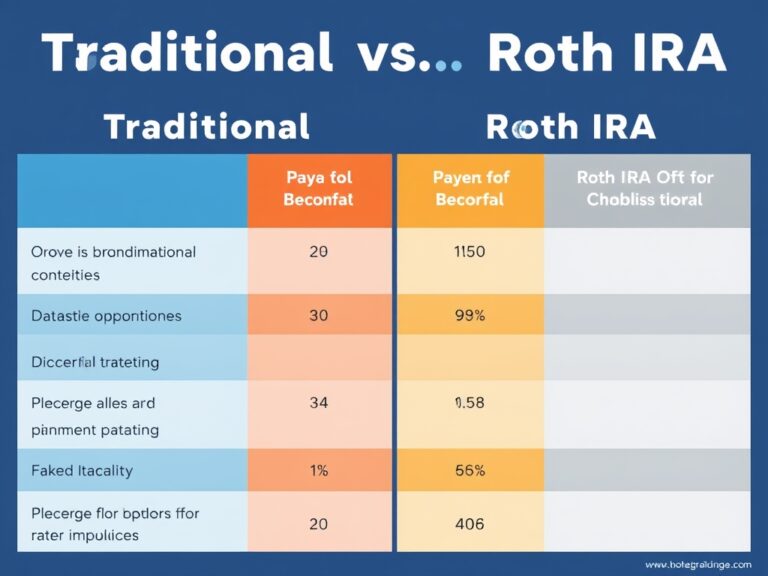
Navigating the tax landscape of Roth vs Traditional IRA accounts is essential for maximizing your retirement savings. A Traditional IRA offers an immediate tax break, as contributions are often tax-deductible, but you pay taxes when you withdraw money in retirement. In contrast, a Roth IRA uses after-tax dollars today, allowing your money to grow and be withdrawn completely tax-free later.
- Choose a Traditional IRA if you are in a higher tax bracket now and expect to be in a lower one later.
- Choose a Roth IRA if you want to enjoy tax-free income during your golden years.
- Many experts recommend a mix of both if possible for ultimate tax flexibility.
- Remember that early withdrawal penalties apply to most retirement accounts before age 59½.
- Check the annual contribution limits set by the IRS each year.
- Your choice depends heavily on your current income and future financial goals.
- Tax planning today prevents major headaches during your retirement planning phase.
- Roth IRAs are particularly powerful for younger investors with more time for growth.
- Both accounts act as a tax-advantaged ‘wrapper’ for your investments.
- Automate your contributions to these accounts to ensure you never miss out.
- Don’t let tax confusion stop you from saving; start anywhere and adjust later.
- Consult with a tax professional if you have complex income situations.
Long-Term vs Short-Term Investment Strategies
Deciding between long-term vs short-term strategies often defines your success as an investor. Long-term investing focuses on the ‘buy and hold’ philosophy, aiming to capture the growth of the market over 10, 20, or 30 years. Short-term strategies, such as day trading or swing trading, involve buying and selling assets rapidly to catch price movements, which is often much riskier.
- Long-term investing significantly lowers your stress and time commitment.
- Short-term trading is often considered more of a job than an investment strategy.
- Market timing is notoriously difficult, even for the most seasoned professionals.
- Most wealth is built through patience, not by chasing the latest trends.
- Long-term strategies benefit from the tax advantages of long-term capital gains rates.
- Avoid the urge to panic-sell when the market takes a temporary dip.
- Successful investors stay the course regardless of daily news headlines.
- Use your long-term portfolio as the bedrock of your financial safety net.
- Only allocate speculative ‘play money’ to short-term trading if you absolutely must.
- The compounding effect is most potent over long time horizons.
- Discipline is the greatest differentiator between successful and unsuccessful investors.
- Keep your strategy aligned with your life goals rather than daily market noise.